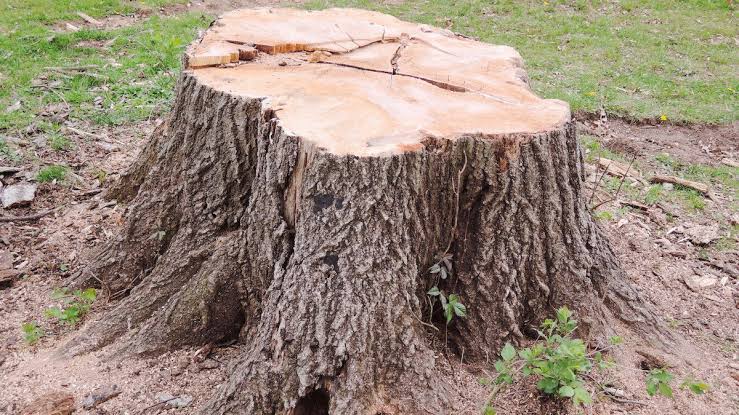
You want a yard you can mow, plant in, and use again without steering around an old obstacle. So if you’re wondering what to do with a tree stump, the short answer is grind it out. Grinding is quicker than waiting, easier on your grass than digging, and safer than fire. It leaves you dirt and chips instead of a hard knot of wood.
The rest depends on your yard, your budget, and how soon you want that space back. Here’s how the choices stack up around Clyde and Callahan County.
Why Stumps Cause Trouble
Stumps cause trouble because they rot slow, draw insects, and tie up ground you paid for. A live oak or mesquite stump can sit in our clay soil for many years. It breaks down slowly on its own. Hot dry summers stretch that out even further. Wood that stays put that long turns into an invitation. Termites, carpenter ants, and borers move into soft wood. A stump near the house puts them close to your siding and porch posts.
Mesquite adds a headache of its own. Cut one down and the stump and roots often push up suckers. Those thin whips of new growth keep coming back all season. You can mow them off, but they return until the root system finally dies.
Then there’s the everyday nuisance of having it there. A stump hides in tall grass, chews mower blades, and stubs toes at dusk. It blocks the spot where you wanted a swing set, a shed, or a new shade tree. Out on rural acreage, a row of leftover trunks blocks a straight pass with the mower or tractor.
Your Options Compared
You’ve got four real choices: leave it and wait, dig it out, burn it, or grind it. Each one fits a different situation, and only one of them is easy on a finished yard.
Leaving it alone is free, and that’s about all it has going for it. In our soil and our heat, a hardwood stump takes many years to soften. Some folks try to speed that up with chemical stump killers off the hardware store shelf. Those work slowly at best, and we don’t do chemical work, so we can’t call it a shortcut. If the leftover trunk sits way out in a back pasture, waiting may be fine. Near a home, waiting mostly gives bugs time to settle in.
Digging out the whole root ball is thorough, but it tears up a big patch of ground. You’re pulling a mass of roots that spreads wider than the trunk, and clay does not let go easily. What you get is a crater, a dirt pile, and a lawn repair job bigger than the stump was. That approach makes the most sense on construction sites where the ground is being reworked anyway.
Burning sounds simple, and it rarely is. A stump burns low and slow, and roots carry heat underground. A dry Callahan County summer usually comes with a burn ban. Wind shifts, the grass is crisp, and a smoldering stump can hold fire for days. It isn’t worth the gamble near a house or a barn.
Renting a grinder is the do-it-yourself version of the right answer. Rental machines are small, slow, and rough on people running one for the first time. A job you figured for an afternoon can eat a whole weekend. The machine beats you up while it does. If you’d rather hand the work off, read up on how to choose a tree service company first. Our other tree care articles cover good questions to ask.
Why Grinding Usually Wins
Grinding wins because it takes the problem out without wrecking the yard around it. A pro machine cuts the stump well below grade. Grass grows over the spot and your mower never knows it was there. The chips fall right back into the hole, which means no crater and no hauling dirt in. That spot settles slowly as the chips break down.
Roots left in the ground aren’t a worry in most cases. Once the stump is gone, they die and decay naturally over the next few seasons. Mesquite suckers quit coming back too, since the growth above ground is gone for good.
Price depends on plain things: stump size, how many you’ve got, and how far the roots run. Access matters too, since we need to get a machine back to it. One beside a driveway is a different job than one behind a fence line on forty acres. Rick has 20 years in tree work and three years serving Clyde. We take rural acreage jobs other crews skip. We’re insured, we’re a local owner-run crew, and our estimates are free and usually same-day.
After the Stump Is Gone
Once it’s out, you’ve got a shallow bed of chips and a spot ready for whatever comes next. Give it a few weeks to settle, then topdress with soil and reseed or lay sod. Water it more than you think in July. Clay dries hard, and new grass gives up fast in our heat.
Planting a new tree there works fine. Just offset the hole a few feet from the old root mass. Young roots need loose ground to spread into. Mulch it, water it deep, and you’ll have shade back sooner than you’d guess.
Ready to get that leftover trunk out of your way? Our stump grinding crew can look at it and give you a straight price the same day. Call or text Rick at 325-225-2680. Someone answers any hour, and we stand behind the work with a satisfaction guarantee.